TL;DR
AI agent observability means understanding what an agent did, why it did it, and what changed because of it.
For coding agents, that means more than prompts and model responses.
It means tracing:
prompts
agent sessions
files read
files changed
commands run
tests executed
diffs produced
rollback points
lines of code created by specific prompts
Traditional observability helps teams debug software systems.
Coding-agent observability helps developers debug the work that changed the system.
AI agents made observability personal
Observability used to be mostly about production systems.
A service goes down. Latency spikes. Error rates climb. A database query slows down. Engineers inspect logs, metrics, and traces to understand what happened.
Then AI agents arrived.
Now the thing you need to observe is not only your application.
It is the agent touching your application.
That changes the question.
Before:
Now:
That question is becoming more urgent as coding agents move from autocomplete to real work.
Claude Code, Cursor, Codex, OpenCode, Cline, Aider, Devin, and other AI coding tools can edit files, run commands, change tests, modify configs, and create pull requests.
That is not just “AI assistance.”
That is an execution path.
And execution paths need observability.
What is AI agent observability?
AI agent observability is the ability to inspect and understand an agent’s behavior across a task.
A useful agent trace can include:
the user prompt
model responses
tool calls
retrieved context
files read
actions taken
intermediate decisions
errors
latency
cost
outputs
final result
In production AI applications, observability platforms usually focus on tracing requests across prompts, model calls, retrieval steps, tool calls, latency, cost, errors, and evaluations.
That is useful.
But coding agents create a more specific problem.
They do not only return an answer.
They change a repo.
So coding-agent observability needs to answer one extra question:
That is where normal LLM observability starts to feel incomplete.
Coding agents are not just chatbots
A chatbot produces text.
A coding agent produces system changes.
That difference matters.
If a support chatbot gives a bad answer, you need to trace the prompt, retrieved documents, model response, and evaluation.
If a coding agent breaks your auth flow, you need more.
You need to know:
Which prompt caused the change?
Which files did the agent read?
Which files did it edit?
Which command changed the repo?
Which tests did it run?
Which line came from which prompt?
Did it change tests to fit the implementation?
Did it edit generated files?
Did it touch a sensitive path?
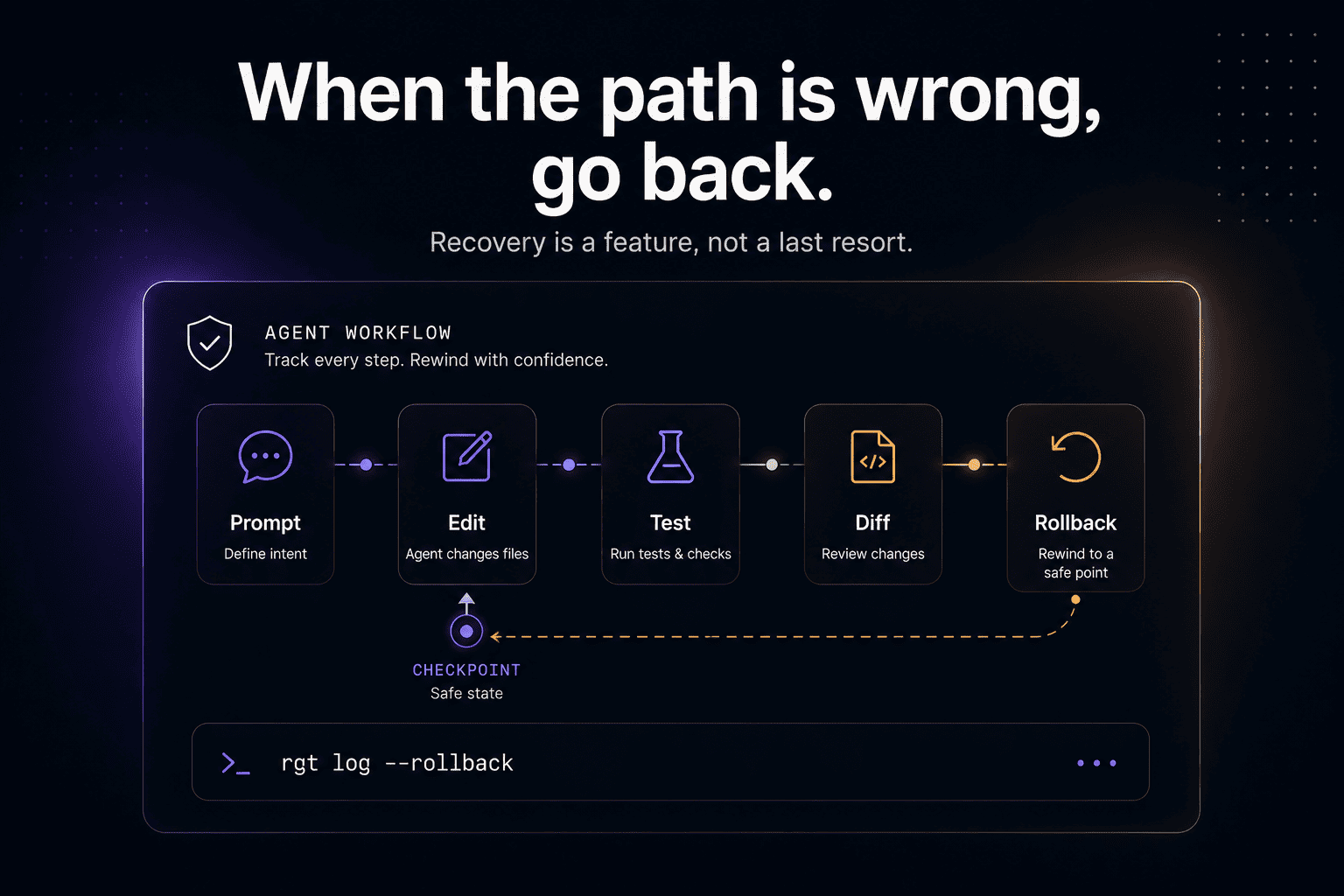
Can you rewind the session?
Can you keep the useful changes and discard the bad ones?
That is not generic LLM observability.
That is developer workflow observability.
Logs are not enough
Logs are useful, but logs alone are a weak interface for agent work.
A log might tell you:
That helps.
But it does not answer:
A better trace tells you:
That is closer to the kind of observability developers actually need.
The goal is not to collect more text.
The goal is to create a useful engineering record.
Traces matter because agents are multi-step
OpenTelemetry popularized the idea that a trace is made of spans that describe what happens during a given operation. That mental model maps surprisingly well to AI agents.
An agent session is an operation.
Each step can be a span:
For coding agents, each span should ideally connect to the repo state.
A file read is not just a log line.
A file edit is not just an event.
A test run is not just output.
Together, they explain how a prompt became a diff.
The missing signal: code impact
Most agent observability conversations focus on the agent’s reasoning path.
That is important, but for coding agents the highest-value signal is code impact.
A coding agent should be observable across two layers:
1. Agent behavior
What did the agent think, read, call, and decide?
2. Codebase effect
What did the agent actually change?
The second layer is where developers live.
You can have a beautiful trace of tool calls and still not know which prompt produced a specific line of code.
That is the gap.
Coding-agent observability should connect agent behavior to code impact.
That is the core workflow.
Why this matters for debugging agent-generated code
A normal bug can be hard to debug.
An agent-generated bug can be worse because the intent may be missing.
You open the file and see:
Then you ask:
Git can show the commit.
The PR may show a vague description.
The chat may be gone, compacted, or split across sessions.
The agent may have made three attempts before landing on the final diff.
Without observability, you reconstruct the story manually.
With coding-agent observability, you should be able to see:
Now you are not just reading code.
You are reading the work behind the code.
Why this matters for code review
Code review is already under pressure.
AI agents make it worse by increasing the amount of code one developer can produce.
A reviewer might see:
The diff may look reasonable.
But the reviewer still needs to know:
Was this change requested?
Did the agent stay inside scope?
Did it touch files it should not have touched?
Did it modify tests after failing?
Did it run the right verification?
Did it introduce security-sensitive behavior?
Did the developer review each step or only the final output?
Agent observability turns review from:
Into:
That is a much better review artifact.
Why this matters for teams
Solo developers need control.
Teams need accountability.
Once multiple developers use multiple coding agents across a shared codebase, teams will need answers to operational questions:
Which agent changed this file?
Which session produced this code?
Which developer approved the prompt?
Which prompt caused the risky change?
Did the agent run tests?
Did two agents edit overlapping files?
Can we replay the work?
Can we rewind only one session?
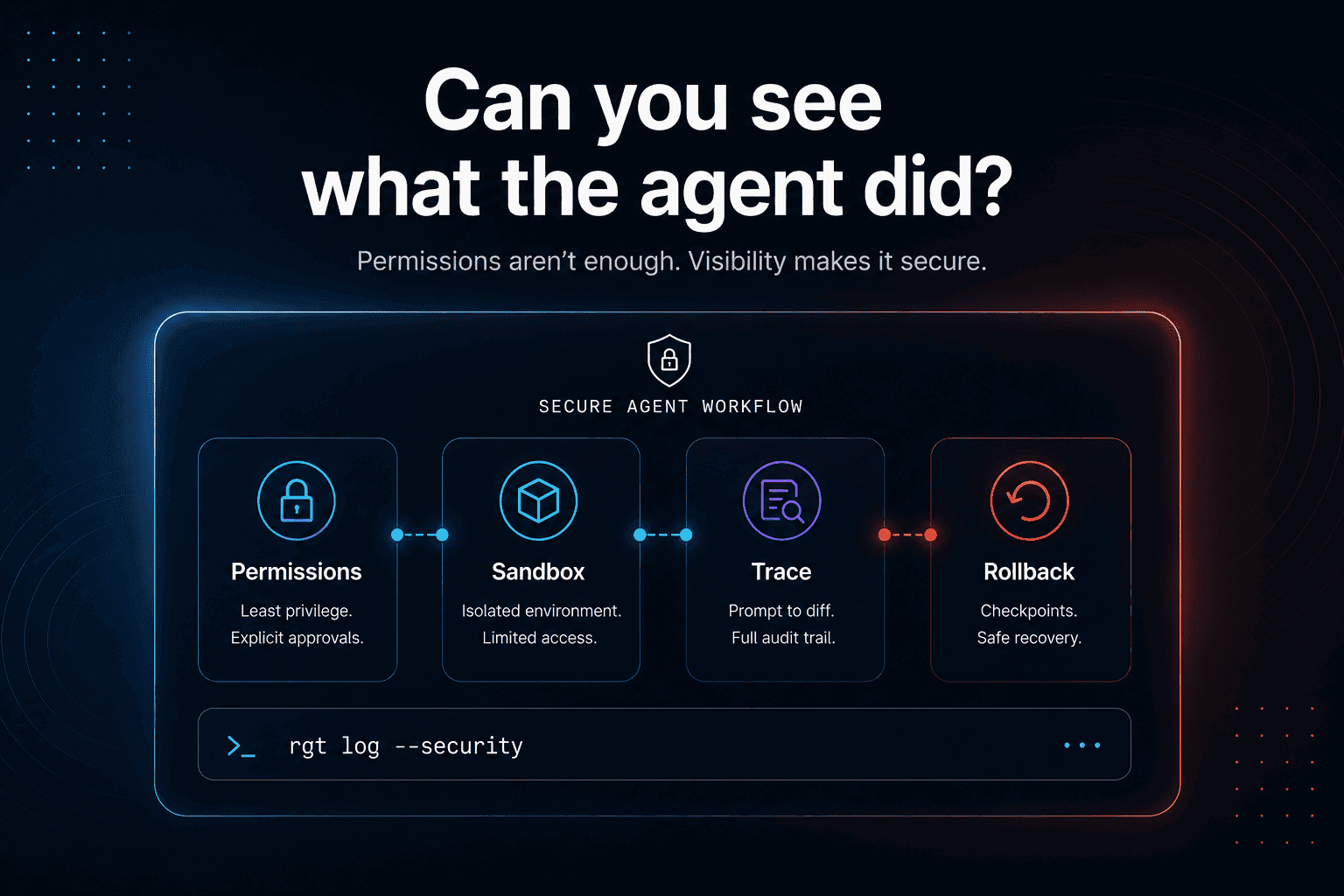
Can we audit agent changes after an incident?
This is where coding-agent observability becomes team infrastructure.
Not because teams want more dashboards.
Because teams need trust.
Generic LLM observability vs coding-agent observability
These categories overlap, but they are not the same.
Layer | What it observes |
|---|---|
LLM observability | prompts, responses, retrieval, tool calls, cost, latency, evals |
Agent observability | decisions, actions, plans, tools, intermediate state |
Coding-agent observability | prompts, sessions, file changes, diffs, tests, blame, rollback |
A coding agent is an LLM agent, but it lives inside a developer workflow.
That means it needs developer-native primitives.
Not only traces.
Also:
log
diff
blame
checkout
rewind
replay
Those are the words developers already understand.
What good coding-agent observability should include
1. Session history
Every agent run should become an inspectable session.
Not a messy transcript.
A structured record.
2. Prompt-to-diff mapping
Every meaningful code change should connect back to the prompt that caused it.
This answers:
3. File-level traceability
The system should show which files the agent read, touched, created, deleted, or modified.
4. Command and test history
If the agent ran tests, builds, migrations, or scripts, that should be part of the trace.
5. Agent blame
Developers should be able to inspect a line and see the agent session, prompt, or step behind it.
6. Rollback points
Observability without recovery is incomplete.
If a trace shows the bad step, developers should be able to go back.
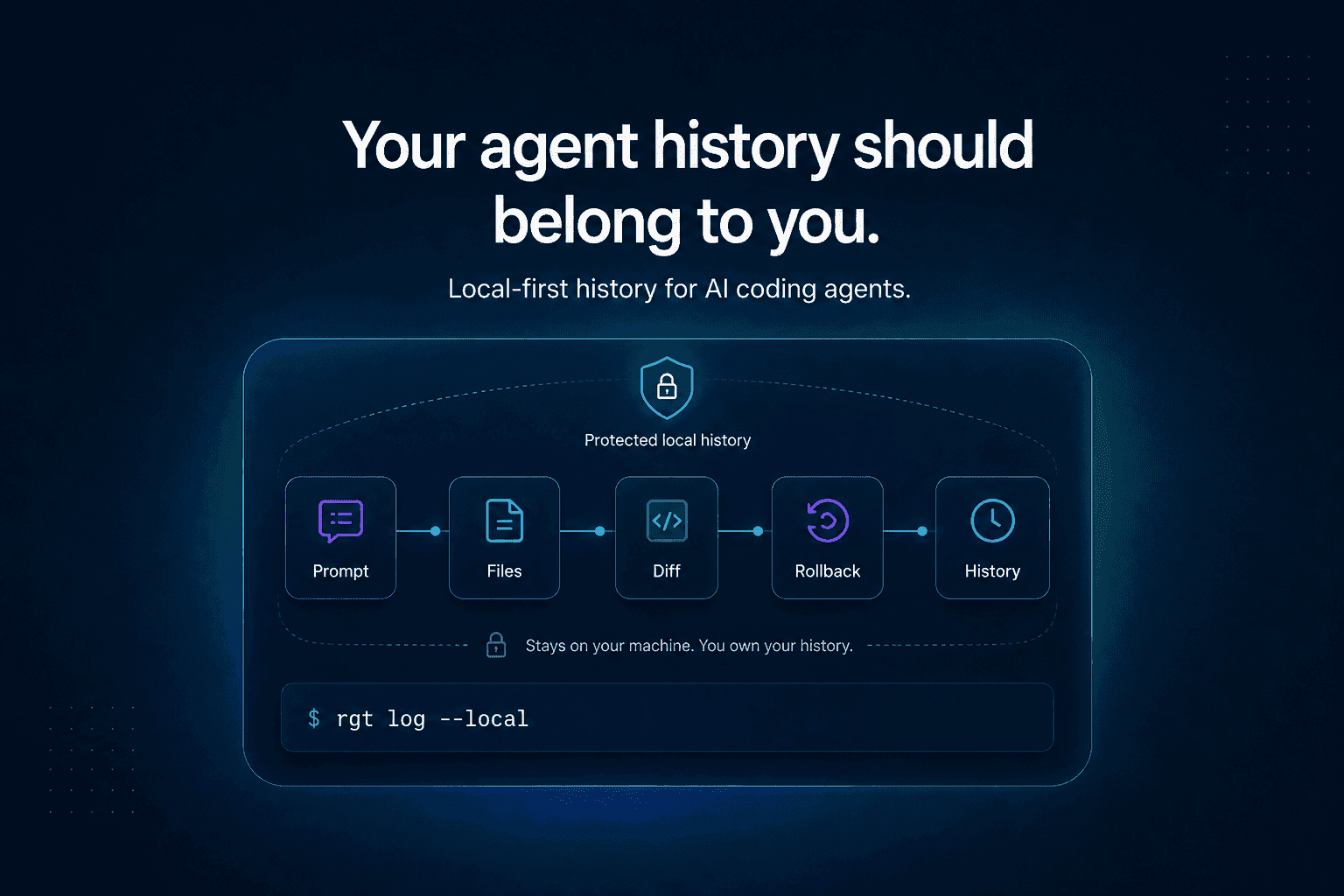
7. Local-first storage
Agent traces can contain sensitive source code, prompts, paths, logs, and internal architecture details.
A serious developer tool should respect local-first workflows.
8. Git compatibility
Coding-agent observability should enhance Git, not replace it.
Git remains the source of truth for code.
The agent layer explains the work that produced the code.
Why “agent audit trail” is not just enterprise language
“Audit trail” sounds boring.
But every developer needs one the first time an agent creates a suspicious diff.
An audit trail helps answer:
It also helps answer:
For AI coding work, auditability is not just compliance.
It is basic debugging.
Where re_gent fits
re_gent is open-source version control for AI coding agent activity.
It is built for the developer workflow side of agent observability:
track what your agent did
see which prompt wrote each line
inspect sessions
blame agent-generated changes
rewind agent work
keep history locally
re_gent does not replace Git.
It adds the agent history Git does not have.
Git tracks files.
re_gent tracks the agent activity that produced those files.
You can find it on GitHub here:
https://github.com/regent-vcs/re_gent
Where The Incident Challenge fits
We also built The Incident Challenge because production debugging exposes the same deeper truth:
When something breaks, the final fix is not enough.
Developers need the path.
Logs, architecture, runtime behavior, evidence, and reasoning all matter.
Coding agents need the same treatment.
If an agent changes a production-critical path, developers should know what evidence led to that change, what the agent touched, and how to reverse it.
That is why agent observability and incident debugging belong in the same conversation.
https://theincidentchallenge.com/
FAQ
What is AI agent observability?
AI agent observability is the ability to inspect how an AI agent behaves across a task, including prompts, tool calls, decisions, actions, outputs, errors, and final results.
What is coding-agent observability?
Coding-agent observability is observability for AI coding agents. It tracks prompts, sessions, file changes, diffs, tests, rollback points, and the connection between agent activity and code changes.
Why do AI coding agents need observability?
AI coding agents can make multi-file changes quickly. Developers need to understand what the agent did, why it did it, which files changed, and how to recover if something breaks.
Is agent observability the same as LLM monitoring?
Not exactly. LLM monitoring usually tracks model calls, prompts, responses, cost, latency, errors, and evaluations. Coding-agent observability also needs to track codebase effects, such as file edits, diffs, tests, blame, and rollback.
What is an agent execution trace?
An agent execution trace is a structured record of the steps an agent took during a task. For coding agents, it should include prompts, files read, files changed, commands run, tests executed, and final diffs.
What is an AI agent audit trail?
An AI agent audit trail is a durable record of what an agent did. In software development, it helps teams understand which prompt or session caused a code change.
How is this different from Git?
Git tracks file history. Coding-agent observability tracks the agent activity that produced those file changes. The two should work together.
Does re_gent replace observability platforms like LangSmith or Datadog?
No. re_gent is focused on local AI coding-agent activity and developer workflows. It is closer to version control for agent work than production LLM monitoring.
Final thought
AI coding agents are not just generating text.
They are changing systems.
That means developers need more than chat history, more than logs, and more than a final diff.
They need observability for the work behind the code.
Because when an agent touches a repo, the question is not only:
It is: